


Accounting involves a wide range of tasks that can be overwhelming. In 2026, the use of digital tools to manage accounting processes has become necessary. Without the right supporting tools, teams remain stuck in manual workflows and time-consuming routines, leading to inefficiencies to keep up with business demands.
In this guide, we’ll explore 5 best tools for accounting that are essential to help automate data entry, streamline cash flow tracking, optimize accounts payable, and drive smarter financial decision-making.
1. OCR Data Capture Automation
Optical Character Recognition (OCR) is a tool that can automate data extraction from scanned or digital PDF documents, making it a time-saving solution for daily data entry. Working Accounting teams are faced with various transactional documents to process, such as invoices and proof of payment. With OCR, data from those documents can be extracted, organized, and converted into structured data for faster input.
Recommendation:
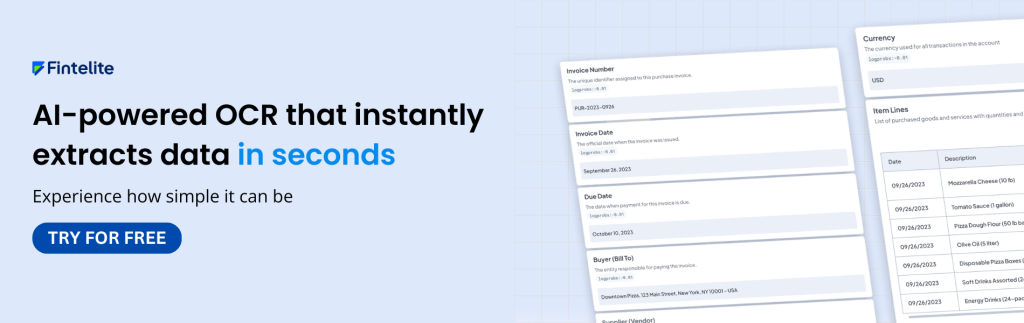
Consider AI-powered OCR like Fintelite to ensure data extraction works accurately across documents. Fintelite supports easy customization to extract only specific data fields as needed. For data entry, it offers multiple export options, including formats such as JSON or XLS, as well as direct integration with your existing applications.
2. Cloud Accounting Software
Cloud accounting software is a platform with a set of features designed to simplify routine accounting and bookkeeping tasks. By leveraging this software, accounting teams can reconcile bank accounts, keep track of business transactions, and manage invoices in real time. One of the key advantages of choosing a cloud-based platform over an on-premise system is that it can be accessed online from anywhere, outside the physical office environment.
Recommendation:
QuickBooks is a leading cloud accounting software that many businesses use today. On this platform, you will find numerous useful features, including connecting bank feeds, tracking business expenses, handling invoices, and more, all within one integrated dashboard. It also supports real-time collaboration by allowing multiple users to access simultaneously.
3. Document Management System
A Document Management System (DMS) is all you need to start organizing all documents within your organization digitally. Utilizing a DMS for accounting can help manage financial records such as invoices, purchase orders, or receipts more efficiently. Not only does it benefit the accounting function, but it also allows businesses to go paperless instead of relying on physical document storage and archiving.
Recommendation:
Docuflo is a Document Management System best for managing financial documents all in one secure and searchable platform. With centralized storage, Docuflo makes it easier for the accounting team to locate specific documents if needed for processing or audit preparation. Its strong compliance controls also ensure sensitive financial documents remain securely stored.
4. Spreadsheets
Spreadsheets are the most fundamental tool that every accountant always uses. While cloud accounting software mentioned before can handle core accounting tasks, Excel remains a valuable complementary tool for data cleaning, formatting, ad-hoc calculations, or advanced tasks that require custom formulas.
Recommendation:
Microsoft Excel is a must-have tool for accounting teams. It allows accountants to efficiently organize, analyze, and manage large financial datasets beyond the capabilities of standard accounting software. Mastery in Excel is essential to perform accounting analysis and make informed financial decisions.
5. Project Management Tools
Project management software is where you can easily plan, organize, and track tasks within an accounting team. In accounting, this tool can be helpful for managing recurring workflows such as month-end closes, audits, or tax filings. By improving coordination, project management tools help accounting teams work more efficiently and reduce the risk of missed deadlines.
Recommendation:
Notion is a project management and collaboration tool that combines task tracking, documentation, and knowledge management in one platform. Accounting teams can use Notion to organize workflows, maintain standard operating procedures, and track deadlines. With tools like Notion, accounting teams collaborate more effectively and stay aligned on responsibilities and timelines.
