
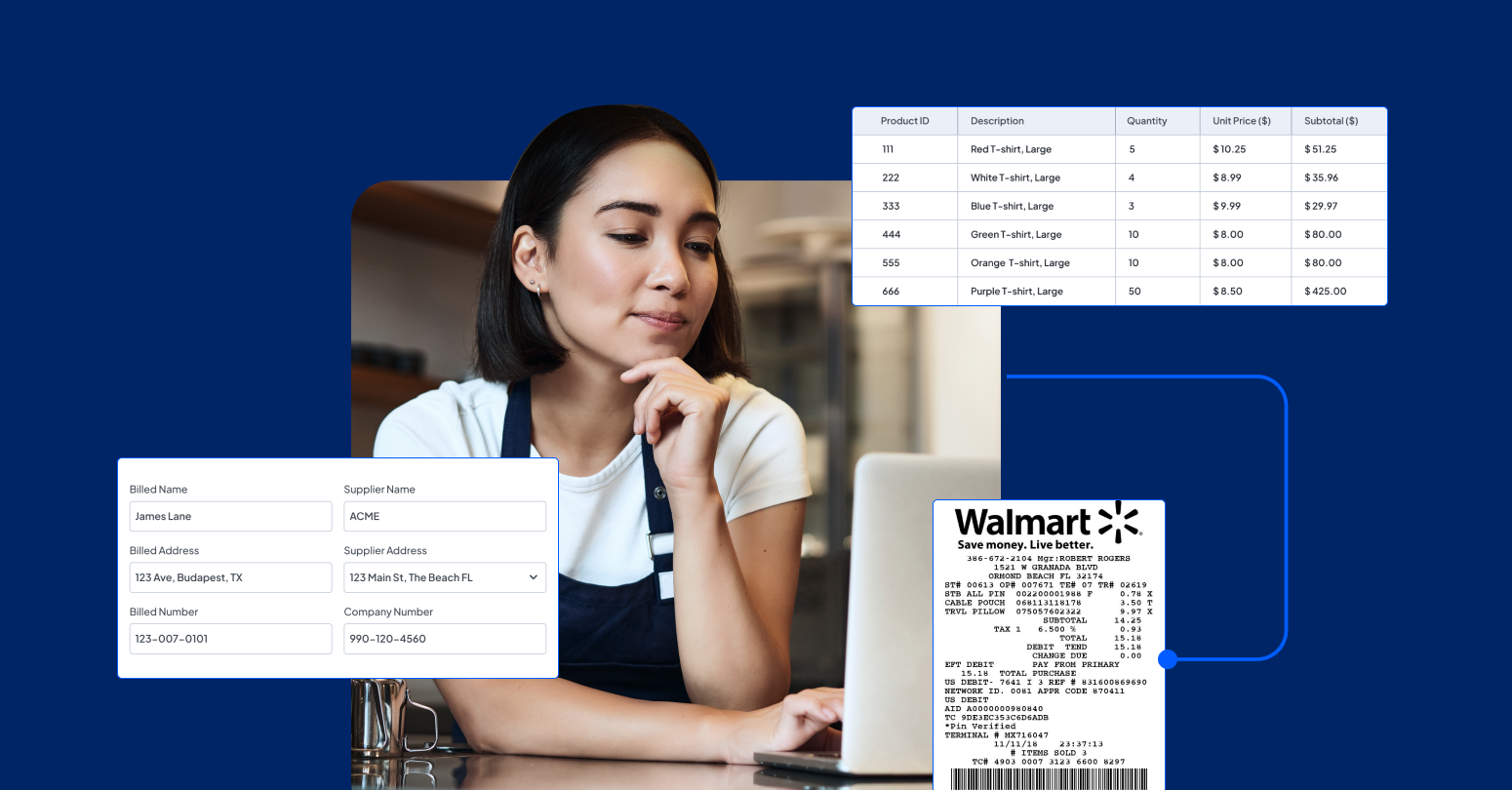

Retail is one of the busiest industries, handling large volumes of documents daily such as invoices, receipts, purchase orders, price labels, and inventory records. Managing this data manually can be time-consuming and prone to errors, especially in fast-paced retail environments. Optical Character Recognition (OCR) technology is widely used to simplify these challenges. By converting printed and handwritten information into digital data, OCR enables retailers to automate data extraction from documents, eliminate the need for manual data entry, and streamline retail operations across functions.
In this article, we explore how OCR improves retail operations in various ways, from automating invoice and receipt processing to enhancing inventory management, helping retailers operate way more efficiently.
Understanding How OCR Works in Retail
Optical Character Recognition (OCR) is a technology that extracts information in documents into data that is easier to work with. An example of OCR would be scanning a document. Using a scanner results in a static image where text cannot be edited. But OCR goes a step further by extracting and converting data into fully usable, searchable, editable. In retail, this capability can be applied for automating data capture from frequently used documents such as invoices, receipts, purchase orders, shipping labels, and other necessary documents for inventory records.
Use Case 1: Streamline Invoice Processing
Invoice processing in retail is often challenged by high transaction volumes and time-consuming manual data entry, which can lead to delayed payments. In this crucial finance task, OCR helps by automatically extracting key data from invoices and converting it into a structured digital format they can quickly process. At an advanced level, OCR can deliver precise data output aligned with your existing data-field templates within your system. Teams can eventually reduce errors and shorten processing time as automation streamlines workflow while ensuring highly accurate invoice data capture.
Use Case 2: Heavy Lifting in Inventory Management
Tracking inventory through manual recording of delivery notes and stock movement documents is time-consuming. OCR removes this friction by turning delivery notes and stock movement records into clean, usable data in seconds. The result is faster stock updates, fewer discrepancies, and clearer inventory visibility. Instead of chasing numbers, teams can focus on controlling stock flow, anticipating demand, and keeping operations aligned across warehouses and stores.
Use Case 3: Accelerate Membership Registration
Retailers with membership programs often require customers to fill in forms during registration. Long queues and fragmented records due to manual forms processing can further complicate the process. OCR therefore can also be applied to streamline this program by instantly extracting customer identity information from every newly submitted form. This implementation benefits both sides, seamless onboarding time for customers, and improved operational efficiency for retailers.
Use Case 4: Enhance Loyalty Rewards Program
Managing loyalty rewards in retail often involves processing receipts, vouchers, and proof-of-purchase documents. Manual validation delays reward approvals and weakens customer trust. With OCR instantly extracting transaction details from submitted documents, reward verification and redemption can be much faster. Retailers can deliver seamless reward experiences with less operational friction, leading to long-term customer engagement and loyalty.
Use Case 5: Optimize Purchase Order Processing
In retail, purchase orders are central to managing procurement and maintaining stock availability across stores annowd warehouses. Each PO defines quantities, pricing, delivery schedules, and payment terms, making accuracy critical. When handled manually, this process becomes slow and prone to mismatches. OCR streamlines purchase order processing by automatically capturing all the necessary data in faster time compared to manual process. This accelerates approvals, improves consistency, and reduces administrative effort, enabling retailers to maintain more responsive supply chain operations.
Conclusion
OCR transforms retail operations across functions, from operational to customer-facing processes. It supports faster invoice processing, accurate inventory tracking, smoother customer onboarding, efficient loyalty management, and streamlined purchase order handling. However, fulfilling these processes at retail scale requires a high-performing solution. Built to answer business needs, Fintelite’s AI-powered intelligent OCR provides a dependable solution to automate data extraction from any document with high accuracy, low latency, and scalable performance.
Jadwalkan Demo to see how Fintelite benefits your business document processing.
