
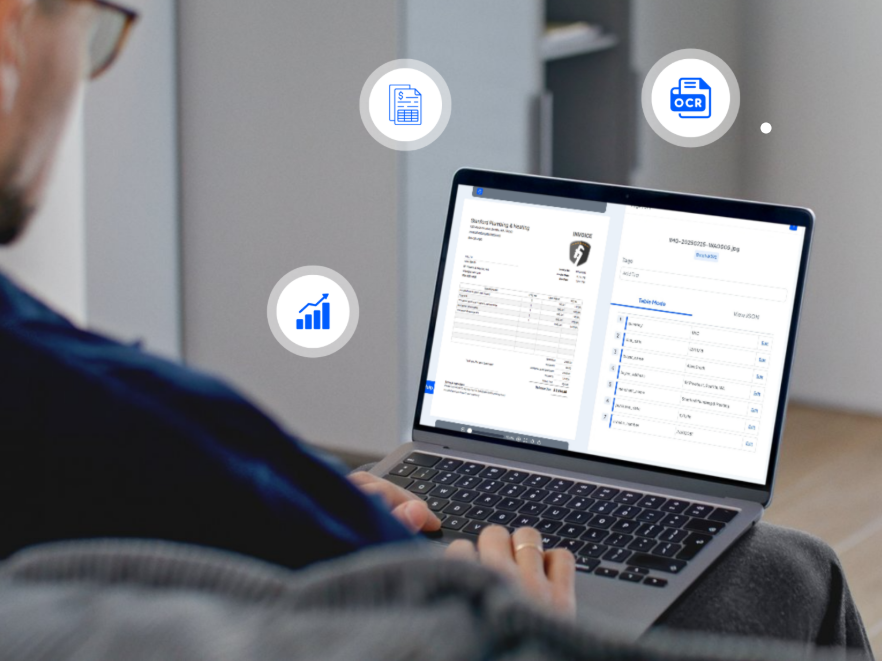
In 2026, logistics operations are faced with increasing pressure to process bills of lading, invoices, and custom documents with greater efficiency. Continue to rely on manual entry limits productivity as it too slow and labor-intensive to effectively handle sudden surges in supply chain demands.
Optical Character Recognition (OCR) technology solves this through automated data extraction. It provides the speed and scalability needed to manage a wide range of documents in logistic more efficiently. This article introduces the top five OCR software solutions on the market, comparing them specifically on automation accuracy and their flexibility to adapt to your unique operational processes.
Why OCR Document Extraction Matters in 2026
Manual document handling is a real cost, not just a slow process. Up to 20% of total transportation costs can be tied to document processing inefficiencies, and digitizing paperwork like bills of lading could unlock billions in savings industry-wide. The problem is structural. Every carrier and customs authority uses a different template, many bills of lading are still handwritten, and tight clearance windows leave little room for manual errors.
A 2024 McKinsey survey found over 85% of logistics leaders value digital projects, yet data quality remains a common gap. Leveraging OCR technology built for logistics closes that gap by handling format variability at volume, without the need for manual data entry.
Top 7 OCR Solutions for Logistics Operations
These seven tools range from no-code platforms to developer-first APIs, each solving logistics document extraction a different way. Here’s how they compare on features, pricing, and deployment.
| Software | Best For | Pricing | Deployment |
|---|---|---|---|
| Fintelite | Logistics teams needing flexible, no-code extraction across custom document types | ~$0.15/page, custom plans available | No-code dashboard, API, or on-premise |
| Lido | Carriers, brokers, and 3PLs needing template-free extraction, including handwritten BOLs | $24–29/mo (100 pages); free tier: 50 pages | Cloud dashboard, API |
| Xtracta | Teams wanting an API-embedded extraction layer with ERP integrations | $0.30–0.50/document | API-first |
| Veryfi | Mobile-first invoice and receipt capture for AP teams | Free up to 100 docs/mo, then $0.08–0.16/doc | Mobile app, API |
| Tesseract | Developers building custom OCR pipelines on no budget | Free (open-source) | Self-hosted |
| ABBYY FineReader | Multi-language, cross-border document processing | ~$16/mo (desktop); $15,000+/yr (enterprise Vantage) | Desktop or enterprise platform |
| Amazon Textract | Engineering teams building custom pipelines into their own TMS/ERP | $1.50–$70 per 1,000 pages, feature-dependent | Cloud API |
Fintelite
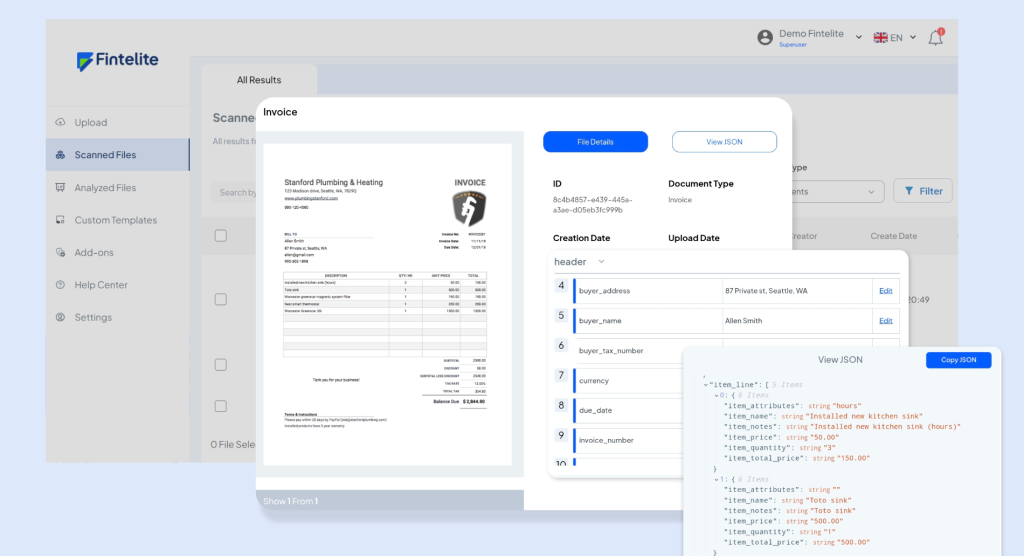
An AI-powered OCR platform built for logistics operations needing document processing to work across any format, without manual setup for every new vendor layout.
Key Features:
- Automated intake from email attachments
- Instantly adapts to layout variations without retraining
- Handles handwritten and scanned documents
- Ready-to-use model for invoices, purchase orders, bill of ladings, and more
- Fully customizable extraction rules to specific fields
- OCR API available with REST endpoints for integration into your existing TMS, ERP, or accounting systems
- Multiple export options to Excel, JSON, or ERP systems
Pricing:
Starting around $0.15/page, with custom plans for high-volume operations. Contact the sales team for a quote sized to your document volume.
Lido
Purpose-built OCR for logistics paperwork , such as bills of lading, freight invoices, packing lists, and customs declarations, including handwritten fields.
Key Features:
- Template-free extraction that adapts automatically to new carrier or vendor layouts
- Direct export to Excel, Google Sheets, or CSV
- Auto-sync to Google Drive or OneDrive
Pricing:
Starts around $24–29/month for 100 pages; free tier covers 50 pages, scaling to enterprise plans for high-volume operations.
Xtracta
Intelligent OCR that transforms unstructured logistics file formats into clean, structured data, learning from every document processed instead of relying on preset templates.
Key Features:
- Identifies relevant fields across a wide range of logistics document types
- Integrates with Xero, NetSuite, SAP, and Microsoft Dynamics
- API automation layer that embeds directly into your existing process
- Converts scanned images and PDFs into actionable data with minimal setup
Pricing:
Per-document rather than per-seat, typically $0.30–0.50 per document depending on volume, with custom quotes for larger operations.
Veryfi
An OCR solution built for speed and mobile convenience. Snap a photo of an invoice and get processed data back in seconds.
Key Features:
- Full mobile accessibility for on-the-go document capture
- Automatic extraction and processing engine
- Connects with Xero and Sage for accounting workflows
- Fast turnaround from photo to structured data
Pricing:
Transaction-based. Free plan covers up to 100 documents/month. Paid plans run around $0.08/receipt and $0.16/invoice (with a $500 monthly minimum), with volume discounts at scale.
Tesseract
A popular open-source OCR tool and a common entry point for logistics businesses just beginning document automation.
Key Features:
- Completely free, with no licensing fees
- High degree of customization for developer-built workflows
- Suited to tailored extraction pipelines (e.g., shipment data, purchase orders)
- Raw text recognition — no built-in structured-field extraction or validation
Pricing:
Free (open-source). Production-ready deployment requires in-house engineering investment.
ABBYY FineReader
A versatile OCR solution for cross-border shipments and international logistics documentation.
Key Features:
- Recognition support across 190+ languages
- Strong handling of multi-language, cross-border paperwork
- Integrates with internal systems for end-to-end document processing
- Scalable from desktop use up to enterprise deployment
Pricing:
Desktop version starts around $16/month per license; enterprise-grade capture (ABBYY Vantage) is quote-based and can run $15,000+/year at scale.
Amazon Textract
A pay-per-page API that pulls raw text, form fields, and table data out of scanned documents — built for teams wiring OCR directly into their own TMS or ERP.
Key Features:
- Plugs into a custom pipeline rather than a ready-made dashboard
- Extracts text, forms, and tables via separate, stackable features
- No practical ceiling on processing volume
- Requires in-house engineering for document routing, error handling, and structuring
Pricing:
Feature-based. Basic text detection starts at $1.50/1,000 pages; Forms + Tables + Queries together (the level most logistics documents need) runs closer to $70/1,000 pages. Free tier: 1,000 pages/month for an account’s first 3 months.
Which One is the Best Fit for Logistics Operations
Those are the top 5 OCR solutions for logistics operations. As we have explored, each solution stands out in its own way. When choosing the right one, it is important to evaluate the following:
From the Logistics Side
- What type of documents need to be automated first?
- Do you need OCR in an easy-to-use dashboard or API integration?
- What is your document volume?
- Do you handle document shipments in English or other language?
- What is your budget?
From the Software Side
- How accurate is the data extraction for your specific document type?
- Does it maintain data accuracy even when document formats or layouts vary over time?
- Can the automation be tailored to extract only the data fields your operations require?
- Does it integrate well with your existing ERP, TMS, or accounting platforms?
- Is it easy to set up without heavy technical involvement?
- Does the vendor offer reliable support and regular updates?
How Fintelite Supports AI-Powered Data Extraction
Fintelite AI OCR is designed with powerful features built to solve the complex challenge of documents in logistics operations. It also seamlessly works with a wide range of documents without relying on templates, meaning there is no need for repetitive configuration for every new vendor layout. Achieve >95% accuracy in data extraction from any document type, including freight invoices, bill of ladings, and other logistics-related documents. With flexible input and output channels, Fintelite delivers a solution that easily fits into the way you currently work, minimizing disruption while maximizing automation efficiency.
from your documents?
People Also Asked
It’s software that automatically extracts data from logistics documents such as bills of lading, freight invoices, packing lists, and customs declarations, turning scanned or photographed paperwork into structured, usable data.
Most logistics OCR tools handle bills of lading, freight invoices, customs declarations, packing lists, purchase orders, and delivery notes. However, coverage varies by tool.
Accuracy depends heavily on document quality and whether the tool is purpose-built for logistics paperwork. Purpose-built, AI-native tools like Fintelite ensures accuracy above 90%, even on varied layouts and handwritten fields, while general-purpose OCR tends to perform less reliably on messy scans or non-standard formats.
Tesseract is a solid, no-cost option for basic text recognition. It works well for developers willing to build a custom pipeline around it, but isn’t a plug-and-play fit for most logistics teams.
Pricing varies widely by model: some tools charge per page (roughly $0.01–$0.15), others per document (around $0.30–$0.50), and enterprise platforms can run into the thousands per year. Open-source options like Tesseract are free but require engineering time to implement.