


Verifying the authenticity of sensitive documents, such as identity and asset ownership, is a critical step every business must take to prevent fraud. Document verification services have become a widely utilized solution, integrating with official data sources to make the process more reliable. However, the experience often still falls short: users are required to manually key in information from the documents to proceed.
This is where OCR steps in to make a difference. OCR (Optical Character Recognition) automates quick data extraction, so users don’t have to. With this advancement in place, document verification becomes even more seamless and efficient. In this article, let’s explore how OCR fits into the document verification process and why it matters.
What is OCR in Document Verification
At its core, OCR is a technology that converts text within images or scanned documents into machine-readable data that computer systems can easily process. A simple example is an ID card image, where OCR can pull out details such as name, date of birth, and ID number just as accurately as a human would, but in a fraction of the time.
This capability is exactly why OCR is a perfect solution to automate data intake across many business processes, including document verification. When applied to document verification, OCR works across a variety of document types, such as:
- Identity documents: national ID, passport, driver’s license
- Ownership documents: vehicle registration, property certificates
- Financial documents: bank statements, financial statements, tax records
- Business documents: company registration, business licenses
How OCR Fits Document Verification
OCR plays a key role in streamlining data collection, sitting right at the beginning of the document verification process. Here’s how it works:
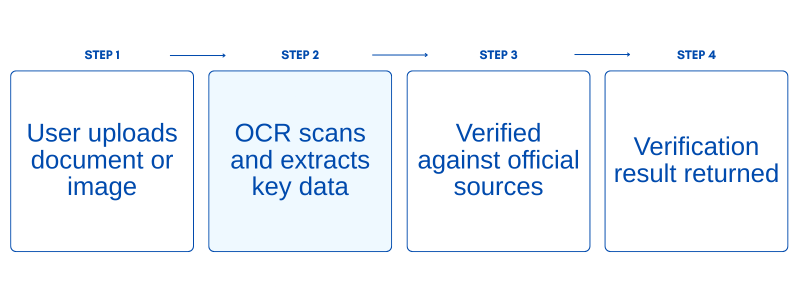
By automating the data extraction step upfront, OCR removes the need for manual input entirely. Users can quickly move to document to the validated result in seconds, making the overall verification process faster, smoother, and far less prone to human error.
OCR Benefits in Document Verification
Implementing OCR into the document verification service brings a wide range of benefits, both for the service provider looking to streamline operations and for the users who rely on it.
1. Faster Data Intake
Reduce unnecessary friction from manual data entry with OCR. Users only need to upload their document, and all important data will be automatically captured. This makes a compelling addition that sets your document verification service apart from others that still rely on manual input.
2. More Accurate Results
Manual input leaves room for mistakes that can cause verification delay. OCR precisely captures data straight from the source, resulting in cleaner, more reliable data that leads to more accurate verification outcomes.
3. Built to Scale
As verification volumes grow, OCR consistently maintains the same speed and accuracy for every submission. Even at peak processing loads, users continue to enjoy a smooth verification experience without downtime.
What to Look for in an OCR Solution
Now that you’ve explored why OCR matters for an efficient document verification service, the next step is finding the right provider. Not all OCR solutions are built the same, here are three key factors to consider.
1. OCR Reading Accuracy
Look for a provider with a proven high accuracy rate across varying document qualities and formats, especially with those document types that are commonly processed in your services.
2. Integration and Reliability
Seamless integration that fits into your existing tech stack is important. Reliable uptime and solid technical support ensure your service keeps running smoothly without unexpected disruptions.
3. Data security
Since this involves sensitive documents, security is a priority. Make sure the OCR complies with relevant data protection standards and regulations in processing data end to end.
Fintelite AI-Powered OCR for Modern Document Verification System
Fintelite offers an enterprise-grade OCR API with seamless processing for a wide range of document formats. Your users send documents in PDF, scans, or image files. Fintelite efficiently processes multiple formats with >95% accuracy, extracting critical fields and converting them into clean, verification-ready data for cross-referencing against government sources. Embed our automated data extraction directly into your SaaS with tailored schemas that match your verification workflows and compliance requirements. Built for high-volume operations, Fintelite helps you deliver faster turnaround times while scaling reliably across hundreds of document verification demands.
Document Verification Services
