

Cross-document validation is the process of matching, comparing, and verifying data between two or more documents. This process is critical to ensuring the consistency, accuracy, and completeness of information before any decision is made. Traditionally, employees must go through each document, identifying specific fields, comparing values, and checking for inconsistencies. It has been a highly manual process that is time-consuming and error-prone as volumes grow.
Modern AI and OCR technologies now introduce a smarter way for businesses to perform cross-document validation efficiently and at scale. By automating data extraction and matching across documents, teams can quickly catch discrepancies in seconds rather than hours. Automation is especially valuable here, as it can help reduce processing time without compromising compliance.
What Cross-Document Validation Checks For
Depending on the use case, what needs to be evaluated across documents can vary. Here are several common types of validation used to assess different aspects of accuracy and consistency.
Field-Level Validation
Compare specific data points, such as names, dates, ID numbers, or amounts, across two or more documents to confirm whether they match. A misspelled name, mismatched amount, or incorrect date can be identified as an inconsistency that needs further review.
Value or Data Validation
Check whether information is not just consistent, but also valid against defined ranges, formats, or business rules. For example, this could mean confirming that a date falls within an acceptable range, or that a number follows the expected format (such as a valid tax ID or currency value).
Cross-Reference Validation
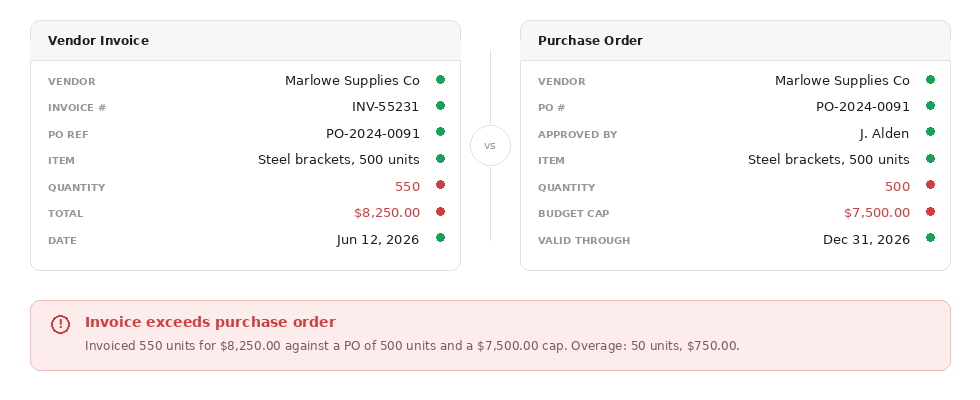
Review whether information in one document logically supports or aligns with related information in another. A common example is verifying that the amount listed on a purchase order corresponds correctly to the amount billed on its associated invoice during accounts payable.
Challenges When Matching Data Across Documents
Reviewing data from multiple documents comes with several challenges, especially when performing it manually. Frequent bottlenecks that happen are:
Growing Document Volume
As businesses expand, the number of documents that need to be validated also increases. Teams are forced to spend significant time and effort checking data before making a single decision, which is not efficient at scale.
Varying Document Formats and Structures
Documents arrive from multiple sources, each with its own standard layouts. A field labeled “Total Amount” in one document might appear as “Amount Due” in another, making it difficult to match data accurately without an intelligent system in place.
Manual Review Oversight
The risk of human error becomes harder to prevent, especially under time pressure or when handling high volumes. Failing to identify mismatches can lead to costly downstream errors, such as overpayments or compliance violations.
How to Automate Cross-Document Validation
Manually processing and verifying documents is no longer sustainable as businesses continue to scale. This operational reality highlights the need for a more efficient system for cross-document validation. Fortunately, the combination of AI and OCR technologies presents a powerful solution for businesses to automate data extraction and validation across all required documents. Rather than relying on manual checks at every step, this enables an automated flow from initial document capture to final validation. Here’s a closer look at how automation powers cross-document validation to be faster, more accurate, and scalable.
1. Intelligent Data Extraction
AI-powered OCR (Optical Character Recognition) reads data from documents and converts it into a machine-readable format. Employees no longer need to manually input or search for specific data points, as the system can detect and extract relevant information even when layouts, labeling, or terminology vary across documents.
2. Automated Validation
The system then applies predefined validation logic to compare matched data points. Depending on the use case, this can include checking for exact matches (field-level validation), valid ranges or formats (value/data validation), and logical consistency between related documents (cross-reference validation), as outlined earlier in this article.
3. Approval and Output Delivery
Based on the validation results, the system automatically routes each document accordingly. Exceptions are flagged and sent for human review, while validated documents move directly to the next step, whether that’s an email notification or an ERP system, without manual re-entry.
Want to automate data validation from multiple documents in one go? See how Fintelite makes it possible. Contact our team
Applications Across Industries
Cross-document validation is a common practice across industries like finance, healthcare, insurance, legal services, and government operations, where decisions often depend on information distributed across multiple records. Below are examples of industry-specific processes where automation can help streamline verification across multiple documents.
Finance & Accounting
Organizations can automate cross-document validation to verify financial information before payments, approvals, or reporting.
- Invoices vs Purchase Orders: Verify that billed amounts, quantities, and vendors match approved purchases.
- Bank Statements vs Accounting Records: Reconcile transactions against expense records and ledger entries.
Banking & Financial Services
Financial institutions often automate validation checks during onboarding, lending, and compliance processes.
- Application Forms vs Identity Documents: Verify customer information during onboarding and KYC checks.
- Payslips vs Bank Statements: Validate salary deposits against declared income.
Insurance
Insurance providers use automation to detect inconsistencies and accelerate claims processing.
- Claim Forms vs Supporting Documents: Validate information against medical reports, repair estimates, or invoices.
Legal Services
Legal teams can benefit from automation to verify information across multiple documents to support compliance requirements.
- Contracts vs Amendments: Ensure terms and obligations remain consistent across documents.
- Client Information Forms vs Identity Documents: Verify legal names and entity details.
Frequently Asked Questions (FAQs)
Cross-document validation is the process of comparing information across two or more documents to identify inconsistencies, missing data, or potential errors. It helps organizations ensure that critical data matches across related records.
AI extracts relevant data from multiple documents and automatically compares fields such as names, dates, amounts, addresses, reference numbers, and account details. Any discrepancies can be flagged for review.
The security of automation depends on the solution you choose. Reliable platforms such as Fintelite help ensure that validation workflows are handled securely by using enterprise-grade encryption, access controls, audit logs, and secure data-processing practices to protect sensitive information throughout the validation process.
Yes. Organizations can define custom validation rules based on their specific requirements. Fintelite makes it easy to implement custom validation logic. Simply share your requirements, and our team can help design and build tailored document validation workflow for your business, so you can start the automation right away without any manual setup.